A Long-Term Paid-Search Account That Stayed Above 11x ROAS From Q1 2025 Through Q3 2026
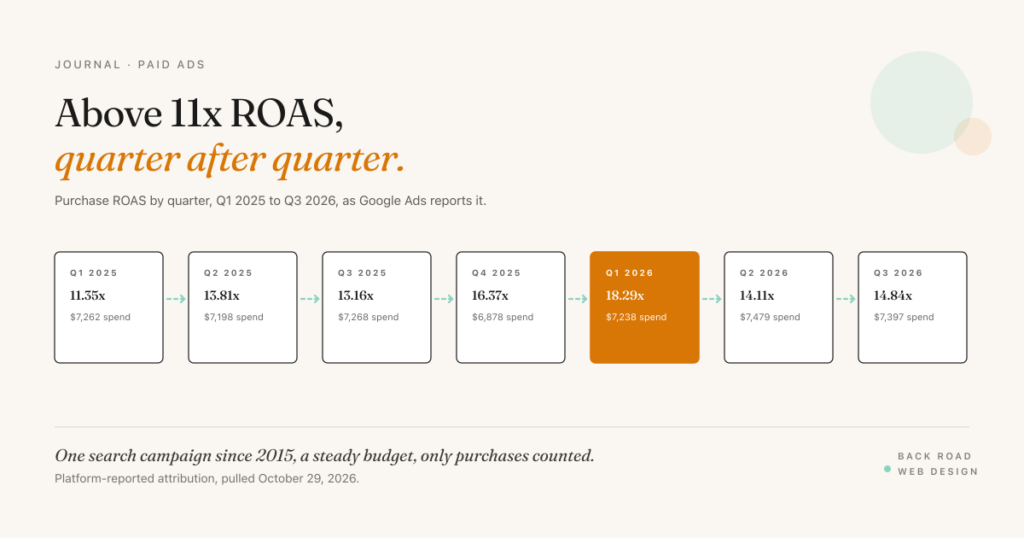
When I first drafted this post, it was about one quarter. A long-term Google Ads account I run had an early read of 11x return on ad spend for Q3 2025, and that looked like the story. Then I pulled the numbers again. The same quarter now reads 13.16x, and it isn’t the best quarter in the account. Every quarter since has done better, Q1 2026 reached 18.29x, and every full quarter from Q1 2025 through Q3 2026 came in above 11x.
So this is a different post now. One strong quarter can be luck. A run of quarters that never drops below 11x is a pattern, and the pattern is more useful to talk about because it comes from habits that are plain to describe: the same search campaign for years, a steady budget, tracking that counts sales instead of steps toward a sale, and new campaign types kept to a small share of spend.
The account
The client is a compliance-training business that sells its courses online, and the relationship is now more than ten years old. Its main search campaign has been running since 2015. A Performance Max campaign runs beside it on a smaller budget.
Every return figure in this post is purchase value divided by ad spend, as Google Ads reports it, counting completed course purchases only. Checkout starts and phone calls are left out. It is also platform-reported attribution. It tells you which sales followed an ad click. It doesn’t tell you how many of those sales would have happened without the ad.
The numbers, quarter by quarter
| Quarter | Ad spend | Purchase value | Return on ad spend |
|---|---|---|---|
| Q1 2025 | $7,262 | $82,455 | 11.35x |
| Q2 2025 | $7,198 | $99,396 | 13.81x |
| Q3 2025 | $7,268 | $95,668 | 13.16x |
| Q4 2025 | $6,878 | $112,624 | 16.37x |
| Q1 2026 | $7,238 | $132,346 | 18.29x |
| Q2 2026 | $7,479 | $105,508 | 14.11x |
| Q3 2026 | $7,397 | $109,797 | 14.84x |
The lowest quarter was 11.35x and the highest was 18.29x. The number moves around from quarter to quarter. The steadier fact is that it never fell below 11x.
It also held at a bigger budget. Spend more than doubled going into 2025, from $3,128 in Q4 2024 to $7,262 in Q1 2025, and the return stayed above 11x at the higher level for every quarter after.
Why the first read of a quarter runs low
Google Ads credits a sale to the day of the ad click, not the day of the purchase. Someone who clicks in late September and buys in October counts toward September. So a quarter keeps picking up sales for a while after it ends.
That is where the original 11x came from. It was an early read of Q3 2025, and the same quarter reads 13.16x today. Q2 2026 did the same thing on a smaller scale: it read 13.49x at the end of July and reads 14.11x now. If you grade a quarter the week after it closes, you’re grading an incomplete one.
Keep the campaign that works
The main search campaign in this account has been running since 2015, and it has carried most of the spend every year since, including about 85 percent of it in 2025. When part of it underperforms, I’d rather fix that part than rebuild the whole thing.
Keeping one campaign also keeps the history in one place. More than ten years of spend and sales under the same campaign makes it easy to compare this quarter with any quarter before it.
Count the sale, not the steps toward it
Every figure above counts completed purchases. Checkout starts used to sit in the account’s main Conversions column too. In mid-2026 they were moved to a secondary action, so they still show up in reports but no longer count toward the main total.
That matters because automated bidding works toward whatever that column counts. Checkout starts are useful to watch, but a checkout start isn’t revenue. Measuring the sale also keeps the reported return honest. It’s the lower, more conservative number, and it’s the one I’d rather stand behind.
Try new campaign types on a small share of spend
Google keeps adding new campaign types. Performance Max showed up in this account in 2022, and it still runs on a small share of the budget, about 15 percent of 2025’s spend. It runs beside the search campaign. It hasn’t replaced it.
The new campaign type gets a share of the budget. The search campaign with the purchase history keeps the rest.
Hold the budget steady
Since the start of 2025, quarterly spend in this account has stayed between $6,878 and $7,479. A steady budget gives the bidding a consistent picture to work from, and it makes quarter-to-quarter comparisons mean something. When spend swings, it gets hard to tell whether a change in return came from the ads or from the budget.
What doesn’t transfer
None of this is a promise that another account will land above 11x. This one has advantages a new account can’t copy on day one: courses sold online with a clear price at checkout, tracking that records the sale itself, a search campaign with years of purchase history, and a budget that has held steady.
A business that sells through phone calls or quote requests can follow the same habits and still see different numbers, because the value of a lead is harder to track than the value of a checkout. ROAS for those businesses depends on how well leads are tied back to revenue.
The part that carries over is the habits. Measure the sale. Keep a working campaign instead of rebuilding it. Test new campaign types on a small share of spend. Wait for a quarter’s sales to come in before you judge it.
What the numbers show, and what they don’t
I point to this account as evidence that a paid-search account can hold a high return for a long stretch when it’s run steadily. It isn’t a forecast for a new account. The first year of any new engagement is mostly about getting tracking right and building up the purchase history that the bidding works from.
For businesses considering whether to invest in paid search at all, or trying to understand whether a current account is on a steady track, the Free Strategy Audit covers the search foundations that paid spend depends on. When those foundations are weak, the same ad budget goes less far.
Let’s look at your ads
Tell me a little about your business and what you’d like to fix. I read every message myself.